
For many internationally mobile families, relocating to Switzerland brings with it a long list of educational considerations. Chief among them — often surfacing quietly over a dinner table or during a school tour — is a deceptively simple question: When should my child start learning to read?

In English-speaking countries, literacy instruction often begins early, sometimes astonishingly so. By the age of five, children in the United Kingdom or United States are typically expected to recognise letters, decode phonics, and read short texts with increasing independence. Early readers are praised, tracked, and — at times — quietly measured against their peers.

By contrast, the Swiss approach is strikingly different. In many cantons, formal reading instruction in the local language does not begin until a child reaches first class — usually around six or seven years old. The philosophy is rooted in a deep respect for developmental readiness: not every child is cognitively or emotionally prepared to read at five, and the system does not demand that they should be.

By contrast, the Swiss approach is strikingly different.
In many cantons, formal reading instruction in the local language does not begin until a child reaches first class — usually around six or seven years old. The philosophy is rooted in a deep respect for developmental readiness: not every child is cognitively or emotionally prepared to read at five, and the system does not demand that they should be.

This divergence can be disorienting for parents navigating more than one cultural system. Especially in bilingual households — or for families whose children are enrolled in local schools while speaking English at home — the question of “when” becomes tangled with a more pressing question of “in which language?”

The truth, of course, is that there is no singular answer. Reading is not a milestone that occurs at a fixed age, like losing a tooth or riding a bicycle. It is a gradual, layered process — one influenced by exposure, home language practices, and, critically, the relationship a child has with the language itself.

In English, early reading instruction often follows a phonics-based model — teaching children how letters correspond to sounds, and how to decode unfamiliar words. In German, the approach can be more fluid, with an emphasis on whole-word recognition and contextual understanding. Neither is objectively superior; each reflects a broader cultural philosophy of how language is internalised.

In bilingual families, this complexity is magnified. A child might speak English at home and attend a Swiss Kindergarten where oral German is prioritised over print.

They may feel confident in both languages — or, more commonly, prefer one and resist the other. Parents, understandably, may worry: Is she falling behind? Should I intervene? Should we do more?

The short answer is: not necessarily.

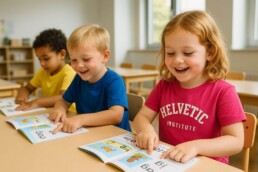
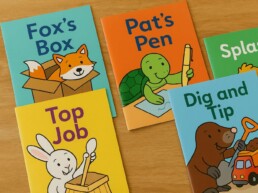
At the Helvetic Institute, we frequently meet families grappling with this balance. Many of our students are learning to read in one language while absorbing another orally. Others have begun decoding in both languages, but with clear preferences or strengths. In all cases, our approach is the same: support, not pressure. We introduce early literacy — particularly in English — through structured phonics, tactile activities, and low-pressure, high-engagement materials that allow children to explore reading as a joyful process, not a race.

Reading, like language itself, thrives in context. A four-year-old leafing through a storybook at home, a six-year-old labelling items in both languages, a child retelling a story from memory in their “stronger” language — these are all forms of literacy, even if not yet fully fluent on the page.

The impulse to worry is natural. But often, what a child needs most is time, consistency, and the opportunity to develop literacy at their own pace — in whichever language they feel most at home.

Whether your child begins reading at four or seven is far less important than whether they feel capable, curious, and supported. Because in the end, it’s not the age that matters — it’s the relationship they build with language itself.

At the Helvetic Institute, we offer early phonics-based English courses tailored to bilingual children navigating both local and international systems. If you're considering structured support for your child’s reading journey, we'd be happy to speak with you. Learn more here.

Privacy Preference Center