

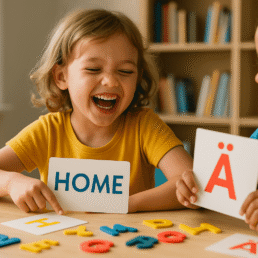
For children learning across two or more languages, joy is not a distraction from progress, it is the mechanism by which progress occurs. Play is not what fills the time between “real lessons.” It is the space in which language becomes lived, internalised, and emotionally safe.
This is especially true in bilingual settings. Language acquisition does not unfold in neat steps. It is rarely linear, and almost never purely academic. A child may learn a new word while building a tower, or discover sentence structure while correcting a friend during a card game. These are not side benefits. They are the work itself.
In bilingual environments, play also removes pressure. One of the most underestimated challenges for children learning in two systems is performance anxiety, the quiet sense that they should “know this by now,” or that they are being watched for correctness. Structured play dissolves that tension. It allows children to take risks, make language their own, and begin using it without translation or hesitation.
And then, of course, there is the matter of joy.
Laughter Belongs Next to Literacy
It is easy to undervalue joy in educational conversations. Parents are understandably focused on milestones, academic standards, future readiness. Schools, too, feel the pressure to deliver outcomes that are measurable and trackable. But in the process, something essential is often overlooked: children learn best when they feel safe, curious, and genuinely engaged. The laughter that bubbles up during a storytelling game in German, the triumph of successfully giving instructions in English during an obstacle course, these moments are not incidental. They are formative.

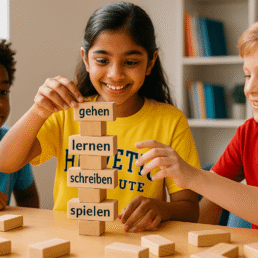
At Helvetic Institute, our language courses are structured, yes , but also open. They include movement, collaboration, and purposeful play not as decoration, but as pedagogy. Whether we are introducing early phonics, supporting second-language learners, or deepening comprehension in a child’s stronger language, we return again and again to the same principle: emotion matters. A child who enjoys learning will seek it out. And a child who feels seen, capable, and included will speak — often before they realise they can.
In the bilingual classroom, joy is not an extra. It’s not the reward at the end of the lesson. It is the lesson. And when joy is present, so too is language.
At the Helvetic Institute in Zug, our language programmes blend structured learning with purposeful play, creating the conditions where language can grow naturally. If you’d like to learn more about our approach, we’re always happy to speak with families.