


Critical Thinkers
At Helvetic Institute, we don’t see AI as a threat to traditional education — we see it as a tool to deepen it.
We are embracing artificial intelligence not just in how we teach, but in what we teach. From robotics to prompt engineering, our classrooms are becoming living labs of innovation. But we remain guided by a simple principle: AI should never replace human thought. It should elevate it.
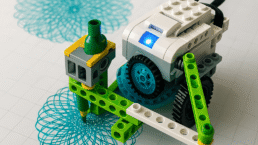
Language Will Always Be Central
Long before a child types their first command or builds a machine, they must speak, read, and think clearly. Phonics. Fluency. Vocabulary. These are not old-fashioned, they’re foundational.
Language is what allows children to ask good questions. It’s what lets them connect with others, present ideas, and build empathy, skills no algorithm can replicate. At our school, English remains a cornerstone, but not the only one. We celebrate multilingualism. Speaking to someone in their own language is not only practical, it is powerful.
We’re Not Just Using AI — We’re Teaching It Responsibly
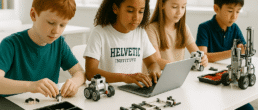
Children experiment with AI tools, but they also learn where AI stops and human judgment begins. They build robots that require trial and error. They work in teams. They learn to think critically and to question outputs — not just consume them.
Teamwork
Collaboration, Not Isolation
We reject the idea that digital learning should be solitary. Our AI and robotics programmes are grounded in communication, creativity, and collaboration. We make space for noise, for teamwork, for mistakes.
A Balanced Approach to 21st Century Learning
Yes, we are future-focused. But we are also grounded. Children still read aloud. They still write with pencils. They still tell stories. These are not opposites, they are complements.
The result? Students who are not just digitally literate, but deeply human
Want to see how we’re shaping the next generation of critical, multilingual thinkers?
Explore our programmes or visit our school in Zug — where children learn to speak, question, build, and connect.
Read More Articles
The Case for Joy: Why Play Is Serious Work in a Bilingual Classroom
For children learning across two or more languages, joy is not a distraction from…
From ABC to Z: When Should Children Start Learning to Read in English or German?
For many internationally mobile families, relocating to Switzerland brings with it a long…